

Daisy Việt Editorial Team
28-08-2026Is Social Media Doing More Harm Than Good to Teenagers?
Researchers are divided over whether social media's design, rather than the technology itself, is what drives its documented risks to adolescent well-being.Lượt xem: 7 Nguồn: Daisy Việt
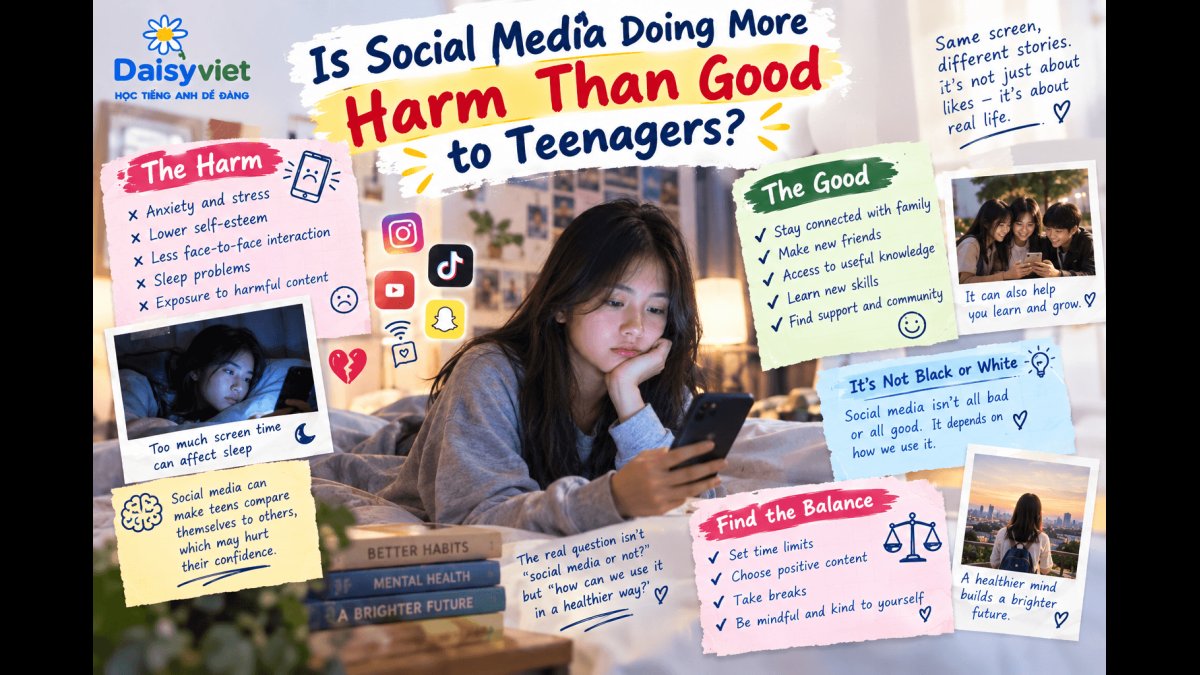
Few technologies have transformed adolescence as thoroughly, or as controversially, as social media. What began as a way for teenagers to stay in touch with friends has evolved into a constant, algorithmically curated stream of content that shapes how young people see themselves, their peers, and the wider world. Whether this transformation has been, on balance, beneficial or harmful remains one of the most contested questions in contemporary psychology.
It is the platforms' underlying business model, rather than social media itself, that many researchers now identify as the true source of concern. Because these companies generate revenue primarily through advertising, their algorithms are designed to maximize the amount of time users spend scrolling, often by surfacing content engineered to provoke strong emotional reactions. The prioritization of engagement over well-being, critics argue, is what distinguishes today's social media environment from earlier, less addictive forms of digital communication.
Evidence linking heavy social media use to poorer mental health outcomes has accumulated steadily over the past decade. Numerous large-scale studies have found associations between extended daily use and elevated rates of anxiety, depression, and body dissatisfaction, particularly among adolescent girls. It would be an overstatement, however, to claim that causation has been definitively established; most researchers instead describe the relationship as correlational, complicated by countless confounding factors that are difficult to isolate in observational research.

Ảnh: Shixart1985, Wikimedia Commons (CC BY 2.0).
Were social media's effects uniformly negative, the policy response might be considerably simpler than it currently is. In practice, however, researchers have found substantial variation depending on how, rather than merely how much, teenagers use these platforms. Passive scrolling through curated feeds correlates far more strongly with negative outcomes than active engagement, such as messaging close friends or participating in interest-based communities, a distinction that complicates blanket recommendations to simply reduce screen time.
The comparison of one's own life to the carefully edited highlights of others' lives is a phenomenon psychologists increasingly regard as central to social media's psychological toll. Adolescents, whose sense of identity is still developing, appear especially vulnerable to this dynamic, repeatedly measuring their appearance, achievements, and social lives against an endless stream of curated, filtered content that rarely reflects the full reality of anyone's daily existence.
Proponents of social media, meanwhile, point to genuine benefits that a purely critical narrative risks overlooking. For marginalized or isolated teenagers, particularly those in rural areas or from minority communities, online platforms can provide access to supportive communities that would otherwise be entirely unavailable. Creative expression, political engagement, and access to educational content have all been cited as meaningful upsides that coexist uneasily alongside the platforms' documented harms.
Legislators in several countries have begun responding with a range of proposed interventions, from minimum age requirements to mandatory design changes intended to reduce addictive features such as infinite scroll and autoplay. Were such regulations to be implemented consistently across major markets, some researchers believe, the resulting changes to platform design could meaningfully alter the risk profile of social media for young users, though enforcement across borders remains a formidable practical obstacle.
Parents and educators, caught between these competing findings, often default to blunt restrictions, banning devices outright rather than attempting the more difficult task of teaching adolescents to navigate digital spaces critically. Some psychologists argue that this approach, while understandable, may prove less effective in the long run than fostering media literacy, given that most teenagers will eventually gain unsupervised access to these platforms regardless of restrictions imposed during childhood.
What emerges from the accumulated research is not a simple verdict but a portrait of significant complexity, in which individual vulnerability, platform design, usage patterns, and broader social context all interact in ways researchers are only beginning to fully untangle. The tentative consensus, insofar as one exists, is that social media is neither uniformly harmful nor uniformly beneficial, but rather a powerful tool whose effects depend heavily on the manner and context of its use.
It is precisely this complexity that makes sweeping policy prescriptions so difficult to formulate responsibly. A ban that might protect one vulnerable teenager could simultaneously cut off another from a community that provides genuine psychological support, illustrating why many researchers now favor targeted, evidence-based interventions over blanket restrictions applied uniformly across an enormously diverse population of young users.
Researchers studying resilience have also begun asking a different question altogether: not simply how harmful social media can be, but which adolescents are best equipped to navigate it safely. Strong offline relationships, stable family environments, and prior experience with emotional regulation all appear to buffer some teenagers against the platforms' more corrosive effects, suggesting that future interventions might focus as much on building underlying resilience as on restricting access to the technology itself.
None of this diminishes the seriousness of the concerns researchers have raised, but it does suggest that the path forward will likely involve far more than simply limiting how much time teenagers spend online.
Grammar Structure (Phân tích Ngữ pháp)
- Cleft Sentence (câu chẻ) — nhấn mạnh thành phần câu bằng cấu trúc "It is... that...": "It is the platforms' underlying business model, rather than social media itself, that many researchers now identify as the true source of concern." / "It is precisely this complexity that makes sweeping policy prescriptions so difficult to formulate responsibly."
- Mixed Conditional / Subjunctive (câu điều kiện hỗn hợp/giả định trang trọng) — đảo ngữ điều kiện thay cho "if": "Were social media's effects uniformly negative, the policy response might be considerably simpler than it currently is." / "Were such regulations to be implemented consistently across major markets, some researchers believe, the resulting changes to platform design could meaningfully alter the risk profile."
- Nominalization (danh từ hóa) & Hedging (rào đón học thuật) — danh từ hóa động từ/tính từ để tạo văn phong học thuật, kết hợp ngôn ngữ rào đón: "The prioritization of engagement over well-being, critics argue, is what distinguishes today's social media environment..."; "It would be an overstatement, however, to claim that causation has been definitively established."

💬 Bình luận (0)