

Daisy Việt Editorial Team
28-08-2026How Microplastics Are Finding Their Way Into Everything We Eat
Tiny plastic fragments have entered the global food chain, and scientists are only beginning to understand what that might mean for human health.Lượt xem: 7 Nguồn: Daisy Việt
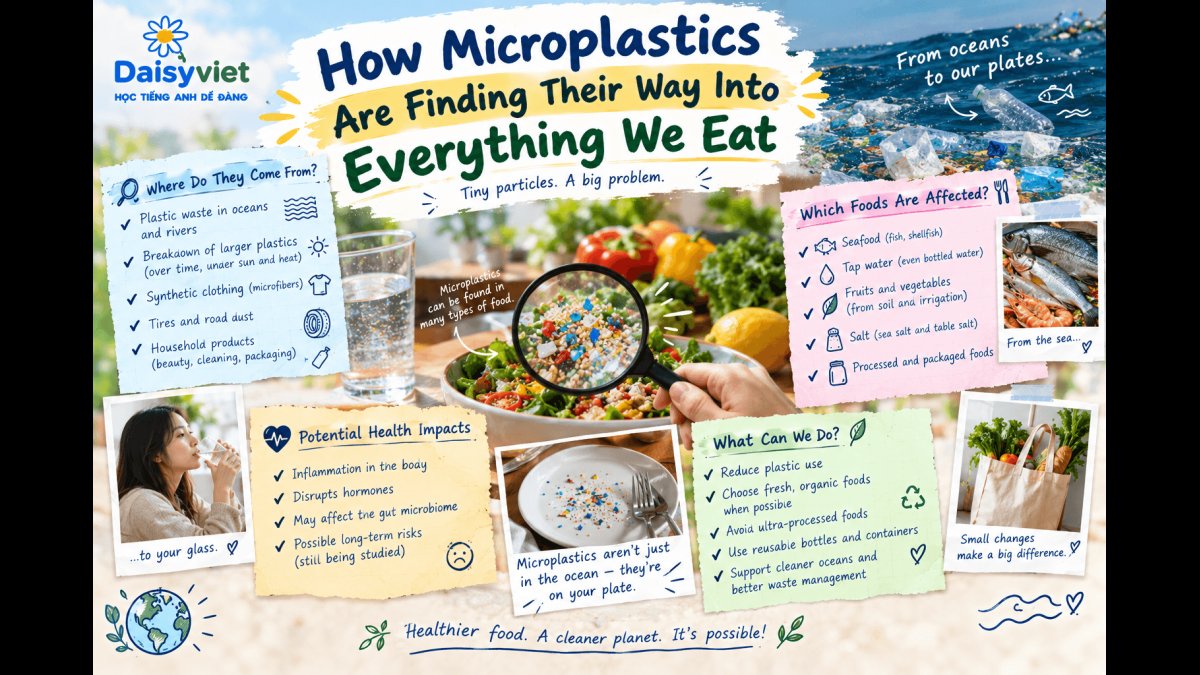
It is not the visible plastic waste littering coastlines that most alarms environmental scientists today, but something far smaller and far less conspicuous: microplastics, tiny fragments of plastic measuring less than five millimeters across, which have now been detected in nearly every corner of the natural world, from the deepest ocean trenches to the air above remote mountain ranges.
These particles originate from a wide range of sources. Larger plastic items, exposed to sunlight, waves, and physical abrasion, gradually break down into smaller and smaller fragments rather than fully decomposing, since most conventional plastics are not biodegradable in any meaningful timeframe. Synthetic clothing sheds microscopic fibers with every wash, tires shed rubber particles with every rotation, and cosmetic products once commonly contained manufactured microbeads before many countries banned their use.
What has troubled researchers most in recent years is the growing body of evidence that microplastics have entered the human food chain on a global scale. Studies have detected their presence in seafood, table salt, bottled and tap water, fruits, vegetables, and even beer, leading some scientists to estimate that the average person may ingest tens of thousands of microplastic particles annually, though such figures should be treated with appropriate caution given the significant methodological challenges involved in measuring particles this small.
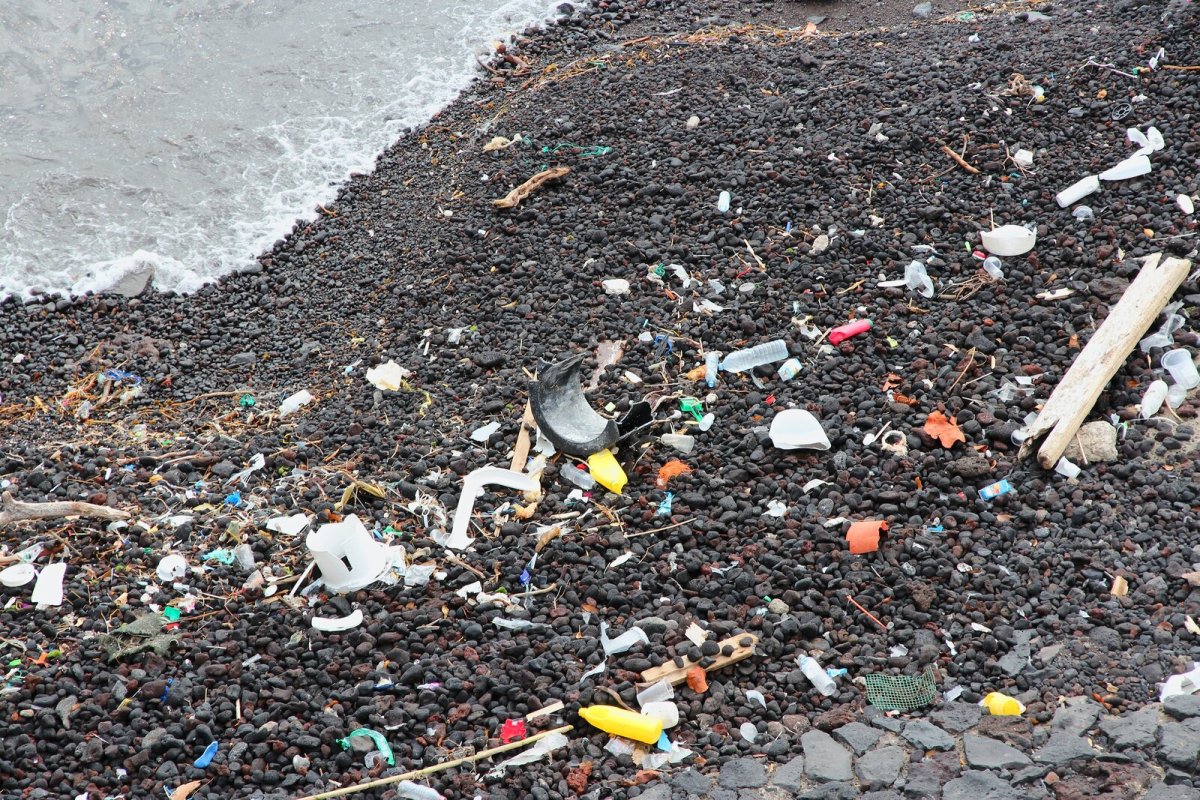
Ảnh: Marek Ślusarczyk, Wikimedia Commons (CC BY 3.0).
The health implications of this widespread exposure remain, at present, poorly understood. It is the sheer novelty of the problem, rather than a lack of scientific interest, that explains why so many fundamental questions remain unanswered. Long-term studies tracking human health outcomes in relation to microplastic exposure simply have not existed for long enough to draw firm conclusions, leaving researchers to rely heavily on laboratory studies involving animals, whose results cannot always be assumed to translate directly to humans.
Were researchers able to isolate the effects of microplastics from the countless other environmental exposures modern humans experience simultaneously, establishing causation would be considerably more straightforward than it currently is. Preliminary findings, nevertheless, have raised legitimate concerns, with some studies suggesting associations between microplastic accumulation and inflammation, hormonal disruption, and, in laboratory settings, cellular damage, though none of these findings has yet been conclusively demonstrated in humans at the exposure levels typically encountered in daily life.
The persistence of these particles in the environment compounds the difficulty of addressing the problem. Unlike many pollutants that degrade relatively quickly, plastic fragments can persist in soil and water for centuries, continuing to break down into ever smaller nanoplastics, particles small enough, some researchers suspect, to cross biological barriers that would ordinarily block larger contaminants, including, potentially, the blood-brain barrier.
Efforts to address the problem have proceeded along two broad fronts: reducing the production of new plastic waste, and improving the filtration systems used in water treatment and manufacturing processes. Several countries have introduced bans on single-use plastics and microbeads, while others have invested in improved wastewater treatment technology capable of capturing a greater proportion of microplastic particles before they re-enter waterways.
Not everyone agrees on how urgently policy should respond, given the considerable scientific uncertainty that remains. Some researchers argue for a precautionary approach, reducing exposure wherever practical even before definitive harm has been established, reasoning that waiting for absolute proof could mean waiting decades while exposure continues to accumulate. Others caution against alarmism that outpaces the current evidence, worrying that premature or poorly targeted regulation could impose significant economic costs without corresponding, clearly demonstrated benefits.
What does seem broadly agreed upon, across an otherwise divided scientific community, is that the sheer scale and permanence of plastic production make this a problem unlikely to resolve itself without deliberate, sustained intervention. Global plastic production has continued rising for decades, and absent significant changes to how plastic is manufactured, used, and disposed of, the quantity of microplastic entering ecosystems and food systems is expected to increase substantially in the years ahead.
For consumers seeking to reduce their own exposure, researchers offer modest, incremental suggestions rather than dramatic promises: reducing reliance on plastic packaging, favoring natural fibers in clothing, and using water filters rated to capture fine particles. None of these individual measures, researchers readily admit, addresses the systemic nature of the problem, which ultimately depends far more on changes to industrial practice and international regulation than on individual consumer choices alone.
Scientists tracking microplastics in the atmosphere have made an equally unsettling discovery: these particles are not confined to oceans, rivers, and soil, but travel considerable distances through the air itself, settling in places as remote as Arctic snow and the summits of mountains far from any obvious source of pollution. This atmospheric mobility, researchers now argue, means that no region of the planet can realistically be considered untouched by plastic contamination, regardless of its distance from major population centers.
International cooperation, several environmental organizations argue, will ultimately prove essential to addressing a problem that respects no national border. Negotiations toward a global plastics treaty have progressed slowly, hampered by disagreements over whether binding production limits or voluntary national commitments offer the more realistic path forward, a debate that mirrors, in many respects, earlier disputes over international climate agreements.
Grammar Structure (Phân tích Ngữ pháp)
- Cleft Sentence (câu chẻ) — nhấn mạnh thành phần câu bằng "It is... that...": "It is not the visible plastic waste littering coastlines that most alarms environmental scientists today, but something far smaller." / "It is the sheer novelty of the problem, rather than a lack of scientific interest, that explains why so many fundamental questions remain unanswered."
- Mixed Conditional / Inverted Conditional (câu điều kiện đảo ngữ) — dùng "Were... to..." thay cho "If...": "Were researchers able to isolate the effects of microplastics from the countless other environmental exposures modern humans experience simultaneously, establishing causation would be considerably more straightforward."
- Academic Hedging (ngôn ngữ rào đón học thuật) — sử dụng động từ tình thái, tính từ hạn định để giảm mức độ khẳng định: "though such figures should be treated with appropriate caution"; "none of these findings has yet been conclusively demonstrated."


💬 Bình luận (0)