

Daisy Việt Editorial Team
02-10-2026The Quiet Power of Boredom
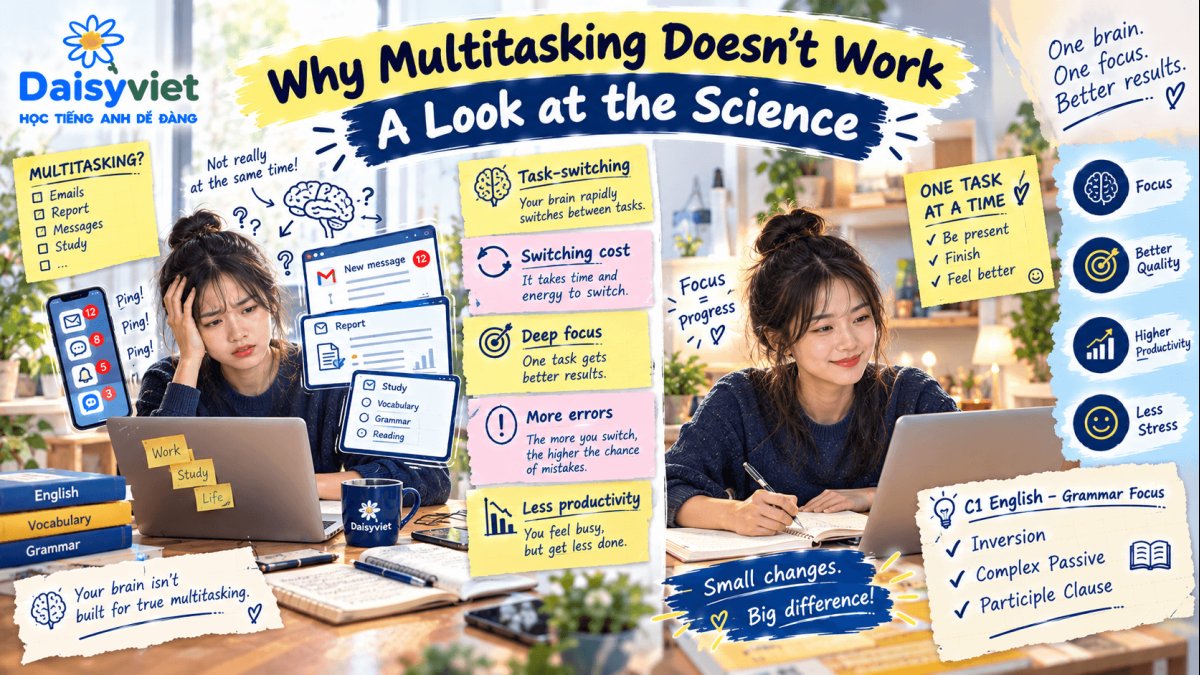
Why do we fill every idle second with our phones, and what might we lose by never being bored? A C1 essay-style reading with practice on inversion, complex passive structures and participle clauses.Lượt xem: 69 Nguồn: Daisy Việt

Rarely do we allow ourselves to be bored anymore. The moment a queue slows down, a lift takes longer than expected or a conversation falls silent, most of us reach instinctively for our phones, filling every idle second with headlines, messages or short videos. Boredom, it seems, has become something to be eliminated at all costs, an inefficiency in an otherwise optimised day.
Yet a growing number of psychologists and writers have begun to question whether this relentless avoidance comes at a hidden price. Boredom is widely regarded as an unpleasant state, and in its chronic form it can certainly be associated with frustration and restlessness. In small doses, however, it is thought to serve a surprisingly useful purpose: it signals that our current activity is no longer meeting our needs and nudges us to look for something more meaningful.
Consider what actually happens when the mind is left without external stimulation. Deprived of a ready-made source of entertainment, it begins to wander, drifting between memories, half-formed plans and loose associations. This apparently aimless state is often where unexpected connections are made. Many writers, scientists and artists have described their best ideas arriving not at their desks but during long walks, train journeys or showers, precisely the moments when nothing else was demanding their attention.
The same tension can be seen in many workplaces, where being visibly busy is often mistaken for being productive. An employee who pauses to stare out of a window may be suspected of slacking, even though such pauses can be exactly when a stubborn problem finally comes into focus. An organisation that leaves no room for unstructured thought may, ironically, be making itself less inventive.
Seen from this perspective, the constant stream of digital distraction does more than simply consume our time. It may deprive us of the mental space in which reflection and creativity tend to occur. Not only does it interrupt the wandering mind before it has had a chance to settle, but it also trains us to expect that every moment should be stimulating, making ordinary experience feel increasingly dull by comparison.
None of this is to suggest that boredom should be romanticised. Parents often feel responsible for keeping children constantly occupied, scheduling one structured activity after another. Some educators argue, though, that children who are occasionally left to their own devices learn to invent games, pursue their curiosity and tolerate a degree of discomfort, skills that are difficult to teach directly but invaluable later in life.
Reclaiming boredom does not require a dramatic retreat from technology. It can begin with modest experiments: leaving the phone in a bag during a short commute, eating a meal without a screen, or resisting the urge to fill a pause in conversation. Having tried such small changes, many people find that the initial restlessness gives way to something calmer, and occasionally to a thought they would never otherwise have had.
Only when we stop treating every empty moment as a problem to be solved, perhaps, will we rediscover what those moments were offering all along: time to think, to notice and to be quietly, productively unoccupied.
Grammar Structure (Phân tích Ngữ pháp)
- Inversion (đảo ngữ) — Rarely / Only when ... + trợ động từ + S + V — nhấn mạnh: "Rarely do we allow ourselves to be bored anymore."
- Complex Passive (bị động phức) — S + is thought/believed/said + to V — nêu nhận định chung một cách khách quan: "it is thought to serve a surprisingly useful purpose"
- Participle Clause (cụm phân từ) — V3/V-ing/Having V3 ..., S + V — rút gọn mệnh đề cùng chủ ngữ: "Deprived of a ready-made source of entertainment, it begins to wander"




💬 Bình luận (0)